Your Summer Peaches Deserve Better Than Jam: The Indian Drinks Changing How Americans Sip
Every August, American home cooks face the same delicious problem: too many peaches, not enough ideas. The jam gets made. The cobbler gets baked. Maybe a batch of peach salsa happens if someone's feeling ambitious. And then, inevitably, a few too-ripe fruits sit on the counter getting softer until they're quietly composted with a small sense of defeat.
Indian culinary tradition looks at that pile of overripe peaches and sees opportunity.
Across the hill stations of Himachal Pradesh — places like Shimla, Kasauli, and Manali, where peaches have grown for well over a century — cooks developed a sophisticated vocabulary for transforming seasonal fruit into drinks, tonics, and liquid condiments that could carry summer's flavor deep into winter. Some of these preparations are probiotic. Some are spiced in ways that make you rethink what a cold drink can be. And almost all of them are easier to make than you'd expect.
Here's a guide to four of the most interesting ones, with recipes adapted for American kitchens and pantries.
Peach Lassi — Not the Sweet Version You're Thinking Of
If you've had mango lassi at an Indian restaurant in the US, you might assume peach lassi is the same idea: fruit blended with yogurt, sweetened, maybe a little cardamom. And that version is genuinely good. But the lassi tradition in northern India has a savory, spiced dimension that rarely makes it onto restaurant menus here, and peaches turn out to be a perfect vehicle for it.
The savory peach lassi common in parts of Himachal Pradesh uses ripe peaches as a base but builds complexity with roasted cumin, a pinch of black salt (kala namak, available at most Indian grocery stores and increasingly at Whole Foods), fresh mint, and a squeeze of lime. The black salt adds a faintly sulfurous, almost eggy depth that sounds strange and tastes remarkable — it rounds out the peach's sweetness in a way that regular salt never quite manages.
To make it: Blend 2 ripe peaches (peeled and pitted) with 1 cup of full-fat plain yogurt, ½ cup cold water, ½ teaspoon roasted cumin powder, ¼ teaspoon black salt, a small handful of fresh mint leaves, and the juice of half a lime. Taste and adjust — you might want a pinch of regular salt or a tiny bit of honey depending on your peaches' sweetness. Serve over ice, topped with a light dusting of chaat masala if you have it.
This is a drink that works as a light lunch, a post-workout recovery beverage, or an interesting alternative to a cocktail mixer. Try it with a splash of gin sometime. You're welcome.
Peach Sharbat — A Spiced Syrup That Does Everything
Sharbat is one of those preparation styles that doesn't have a great English equivalent. It's not quite a syrup, not quite a concentrate — it's a sweetened, spiced liquid designed to be diluted to taste, either with cold water, sparkling water, or milk. Persian in origin and deeply embedded in South Asian culinary culture, sharbat has been made with roses, basil seeds, sandalwood, and dozens of fruits over the centuries. Peach sharbat, particularly from the Himalayan foothills, is one of the more underappreciated versions.
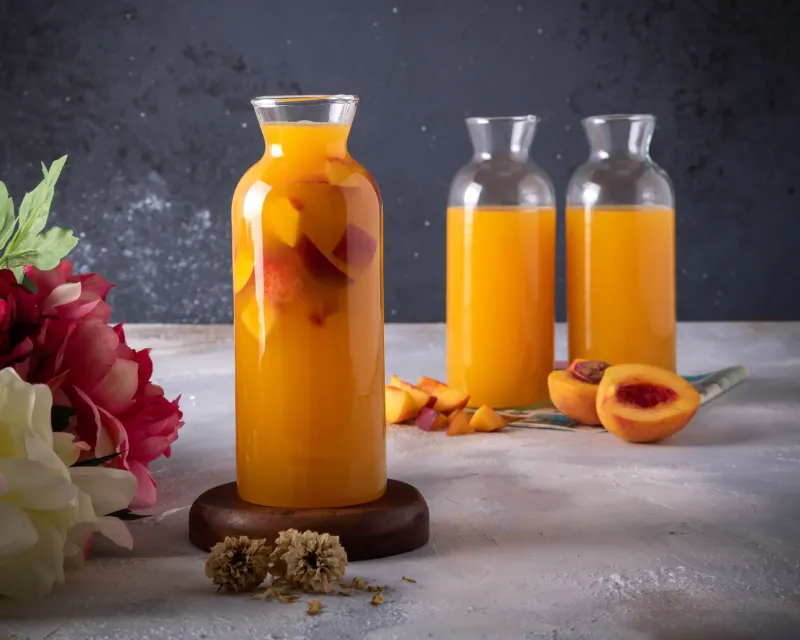
What makes peach sharbat different from a simple simple syrup is the spice layering. A classic version includes whole green cardamom pods, a small piece of cinnamon, saffron (optional but transformative), and sometimes a few dried rose petals. The fruit cooks down with sugar until concentrated, gets strained, and the result is a jewel-colored syrup that smells like summer in a bottle.
To make it: Combine 4 cups of roughly chopped ripe peaches (no need to peel) with 1½ cups sugar, 1 cup water, 4 green cardamom pods (lightly crushed), one 2-inch cinnamon stick, and a pinch of saffron threads in a medium saucepan. Bring to a boil, then simmer for 20-25 minutes until the peaches are completely broken down. Strain through a fine mesh strainer, pressing to extract all the liquid. Cool completely, then bottle. It keeps refrigerated for about three weeks.
To serve: dilute roughly 3 tablespoons of sharbat with 8 ounces of cold sparkling water. Add a squeeze of lime. It's also exceptional stirred into iced tea, drizzled over vanilla ice cream, or mixed into cocktails in place of simple syrup.
Peach Kanji — Fermented, Funky, and Surprisingly Addictive
This one requires a little more patience, but it's the preparation that tends to genuinely surprise people who try it for the first time.
Kanji is a fermented drink with roots in northern Indian culinary tradition, most commonly made with black carrots or beets. The fermentation is lacto-fermentation — the same process that makes sauerkraut and kimchi — and the result is a tangy, slightly effervescent, probiotic-rich beverage that sits somewhere between kombucha and a very good shrub.
Peach kanji is a regional variation that takes advantage of the fruit's natural sugars to speed fermentation and add a floral sweetness to balance the sourness. It's traditionally made in clay pots left in the sun, though a glass jar on a warm countertop works perfectly well in an American kitchen.
To make it: In a clean glass jar (half-gallon size works well), combine 3 cups of cold filtered water with 1 tablespoon mustard seeds (coarsely ground), 1 teaspoon black salt, ½ teaspoon red chili powder, and 2 medium peaches cut into wedges (skin on). Stir well, cover with cheesecloth or a loose lid (you want airflow), and leave at room temperature for 2-3 days, stirring once or twice daily. Taste on day two — it should be getting pleasantly sour and slightly fizzy. When it reaches a tanginess you like, strain it, chill it, and drink it over ice.
The flavor is genuinely unlike anything most American palates have encountered, and people tend to either fall completely in love with it or need a few tries to come around. It's worth the experiment.
Peach Jaljeera — The Drink That Thinks It's a Condiment
Jaljeera is a spiced cumin water that functions as both a digestive tonic and a refreshing summer drink across northern India. It's pungent, herbal, and aggressively flavored in the best possible way. Adding peach to it sounds improbable until you taste it.
The fruit softens jaljeera's sharp edges while adding body and a sweetness that makes the whole thing more approachable. In chaat culture — the world of Indian street snacks — a peach-spiked jaljeera might be poured over crushed ice and served alongside fried snacks as a palate cleanser and digestive aid. In an American kitchen, it's a genuinely interesting alternative to lemonade at a backyard cookout.
To make it: Blend 1 ripe peach with 2 cups cold water, then strain. To the strained liquid, add 1 teaspoon jaljeera powder (available at Indian grocery stores), the juice of 1 lime, a pinch of black salt, and a pinch of regular salt. Stir well and taste — adjust lime and salt as needed. Serve over ice with fresh mint.
If you can't find premade jaljeera powder, a rough approximation: combine 1 teaspoon roasted cumin powder, ¼ teaspoon dried ginger powder, ¼ teaspoon black pepper, and a pinch each of dried mint and amchur (dried mango powder).
Why This Matters Beyond the Recipe
These drinks aren't just interesting flavor experiments. They represent a fundamentally different philosophy about what to do with peak-season fruit — one that prioritizes preservation through transformation rather than simply extending shelf life. A jar of peach sharbat in your refrigerator in January is summer made storable. A batch of peach kanji is a reminder that fermentation is one of the oldest and most elegant food technologies humans ever developed.
And honestly? Your summer peaches deserve this kind of attention. They're only perfect for a few weeks. Make the most of it.